


Beach umbrellas: sun protection
During summer vacation, the urge to head to the beach is irresistible. Once the allotted half-hour of exercise is over, we'll be basking in the sun. Yet, the beach is the place where we are most dangerously exposed to the sun's rays: without natural protection, our eyes and bodies are directly subjected to the brightness and ultraviolet radiation, even if the wind sometimes gives the false impression of not being too hot. It is therefore essential to equip ourselves to ensure optimal protection: sunglasses and sunscreen provide basic individual protection, but a beach umbrella remains the best product for group use.
A professional offering space on a beach would be wise to choose the best parasols for their clientele; resistant, aesthetic and designed to filter the sun's rays, Belveo parasols are ideal for use on the beach.
Choosing the right materials for a beach umbrella: a quality pole and canopy
For a parasol to fulfill its purpose, it must be stable, attractive, durable, and provide effective sun protection. A reasonable price is also expected, reflecting the product's quality. Belveo offers a range of parasols suitable for beach use, customizable in terms of materials and colors. Furthermore, Belveo parasols are fully repairable, with spare parts available on the website and compatible with most of our models.

The parasol pole can be made of wood, steel, or aluminum: on the beach, aluminum or steel are recommended to prevent corrosion, but still require regular maintenance. All equipment used by the sea is subject to wear and tear and should be covered during periods of inactivity, regardless of its durability.
The most commonly used parasol canopy is made of polyester . Guaranteed for two years by Belveo , it offers good durability but can be prone to fading and may not be suitable for the intensive use a professional might put it through. For a beach parasol used frequently during the warmer months, on land heavily exposed to sun, sand, and salt, choosing olefin or acrylic fabric may be more advisable . Olefin fabric is always treated against fading and mold, and comes with a five-year guarantee. Acrylic fabric, on the other hand, has micro-perforations that allow air to circulate, providing welcome coolness for users.
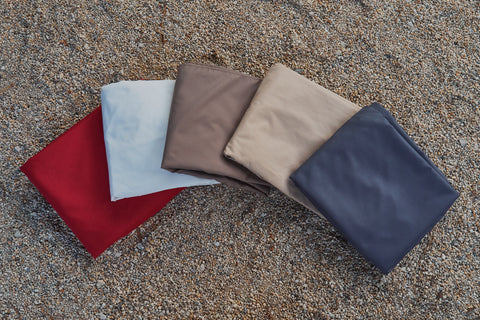
The ribs of Belveo parasols are made of flexible fiberglass. The fiber is solution-dyed to protect the fabric from fading.
Belveo parasols are easy to set up and store, and are suitable for a beach terrace, a campsite restaurant, or a reception in a large garden.
The UPF standard, guaranteeing protection against ultraviolet rays
Since the primary function of a parasol is to counteract the effects of the sun, we expect to be able to measure its effectiveness. The UPF (Ultraviolet Protection Factor) standard quantifies the protection offered against UV rays. A UPF rating of 20 or 30 is generally insufficient to provide adequate shade in an exposed area like a beach. Belveo parasols and shade sails all offer UPF sun protection of 50 or higher, which is ideal for very sunny locations.
Being aware of UV intensity, and therefore the required UPF protection, is essential for assessing the risk posed by the sun. Indeed, in Brittany, it's not uncommon to walk on the beach wearing hats, scarves, and even gloves due to strong winds, but exposure to ultraviolet rays remains high, especially outside the warmer months.
What type of parasol should I choose?
Depending on the layout of the patio or ground where you plan to install the parasol, you can choose from several available models. A straight parasol is effective in the center of a table, or in an area where a pole can be installed without obstructing movement. If you need to shade a large area but prefer to keep the parasol base outside the area, opt for a cantilever parasol with a tilting pole.
The diameter of the parasol also depends on the desired shaded area . The most common models have a diameter of 2 meters, or dimensions of 2 meters by 3 meters, depending on the shape chosen: it can be round, square , or rectangular . A tilting beach parasol with a large rectangular canopy allows you to create shade over a significant area, easily controlled by adjusting the angle of the pole. Depending on your preferences and needs, the canopy diameter of the parasols offered at the Belveo store goes up to 4 meters.
Regardless of the parasol you choose in the store, you'll need to add the weighting system to your shopping list. This system consists of base plates and stands fully compatible with Belveo products, which are assembled with the parasol. If you have any questions, you can ask a sales associate for advice on choosing the right canopy and diameter, as well as the appropriate weighting system. The base itself depends on the diameter of the parasol, as it must ensure its stability. Options include aground anchor , a cross base , or a wheeled base , which allows for easy movement of the parasol. The wheeled base should be weighted down with sand to reinforce the entire structure.

How resistant is a Belveo parasol to rain?
Parasols are not umbrellas, and you shouldn't make the mistake of leaving them exposed to prolonged downpours . However, the fabric of a Belveo parasol is water-repellent, meaning that water will only penetrate it in very heavy rain. During a light, passing shower, the parasol will protect users, but it is designed to block sunlight while allowing air to circulate, and therefore cannot be completely waterproof.

Delivery and transport of Belveo beach umbrellas
Belveo guarantees secure transport of the beach umbrella . If the product is in stock, simply purchase it from the online store: Belveo then indicates a delivery time of 7 to 10 business days , but this timeframe takes into account potential unforeseen transport issues such as strikes and road incidents. Delivery generally occurs less than a week after ordering the beach umbrella.


