


How to choose my flooring?
Weighting is essential when installing a parasol in your outdoor space. Should you use a wheeled base, paving slabs, or a fixed base for your parasol? These solutions have specific characteristics that meet different needs. But what are their differences? And which types of bases or weights are compatible with a straight or cantilever parasol? To help you understand, let's explore these options and their specific features so you can make the right choice.

The wheeled foot
• Easy to move
• The solution that provides optimal security for your installation
• Shade any space, whatever the time of day!
• Foot cannot be moved in the grass
• Larger than slabs
Compatibility : The Kona base is only compatible with cantilever parasols. There are two versions of the Grecale wheeled base, each compatible with cantilever and straight parasols .
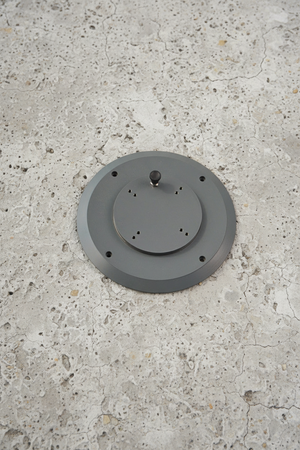
The foot to be fixed
• Saves floor space, can be hidden
• Ground anchoring for maximum stability
• Allows you to easily remove and replace the parasol without tools.
• A safe solution with proper installation
• Not suitable for terraces on pedestals
• Not suitable for non-perforable surfaces.
• More complex installation
Compatibility : The Plug and Play base is compatible with straight and cantilever parasols. If you have a straight parasol (other than 3x3m), you will need a pole base tube .
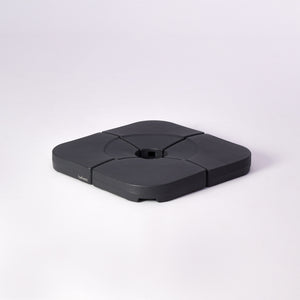
Floor slabs
• Suitable for all types of soil
• Easy to install
• Economical
• Easy to maintain
• It's more difficult to move your parasol
• Must be installed flat
Compatibility : Leste base plates are compatible with all our straight parasols. Ostro base plates are compatible with all our cantilever parasols. For larger parasols, it is recommended to weigh down the base plates with sand to reach 120kg. You will also need a Fogony cross base for straight parasols, except for the 3x3m size.
Tips and tricks for flooring
Do you already have a weighting solution? Do you want to weight your parasol discreetly? Secure your installation? Discover Belveo's tips.

Secure
If you have slabs that are not joined together or do not cover the parasol crossbars, add heavy elements at the crossbars to secure the installation.

Extend
To prolong the lifespan of the slabs, use sand instead of water in areas prone to frost. Store the slabs in a sheltered location at the end of the season.

Fix
You can fix the cross base of your parasol to the ground if you don't want to use paving slabs. All our cross bases have holes at the ends.

Hide
To hide the cross base, consider integrating it under a removable terrace. Alternatively, you can opt for decorative covers or caps that match your outdoor furniture.
Your questions


